
PERFORMANCE
PERFORMANCE | INTERVALS FESTIVAL
ТРАЕКТОРИЯ ИНТЕРВАЛОВ
INTERVALS FESTIVAL
WE
LOCATION
March 13 — October 18, 2026
"Intervals Festival"
exhibition at Sevkabel Port,
St. Petersburg
TEAM
Alexandr Kozlov
Concept Creator
and Project Director
Svetlana Lenichko
Choreographer, dancer, and performer,
founder of the [tanzlabór] project. In her work, she explores contemporary dance at the intersection of movement, media art, and sound, and seeks new forms of performative art.
Kirill Ivanov
Dancer, performer, and teacher; member of the "TANZ.MECHANIKA" troupe at the Sergei Kuryokhin Center and GLYPTIC DC. He works at the intersection of dance, music, and visual art, exploring the possibilities of artistic expression through space and the body.
Polina Nazarova
Photographer
March 13 — October 18, 2026
"Intervals Festival"
exhibition at Sevkabel Port,
St. Petersburg
TEAM
Alexandr Kozlov
Concept Creator
and Project Director
Svetlana Lenichko
Choreographer, dancer, and performer,
founder of the [tanzlabór] project. In her work, she explores contemporary dance at the intersection of movement, media art, and sound, and seeks new forms of performative art.
Kirill Ivanov
Dancer, performer, and teacher; member of the "TANZ.MECHANIKA" troupe at the Sergei Kuryokhin Center and GLYPTIC DC. He works at the intersection of dance, music, and visual art, exploring the possibilities of artistic expression through space and the body.
Polina Nazarova
Photographer
TECHNOLOGY
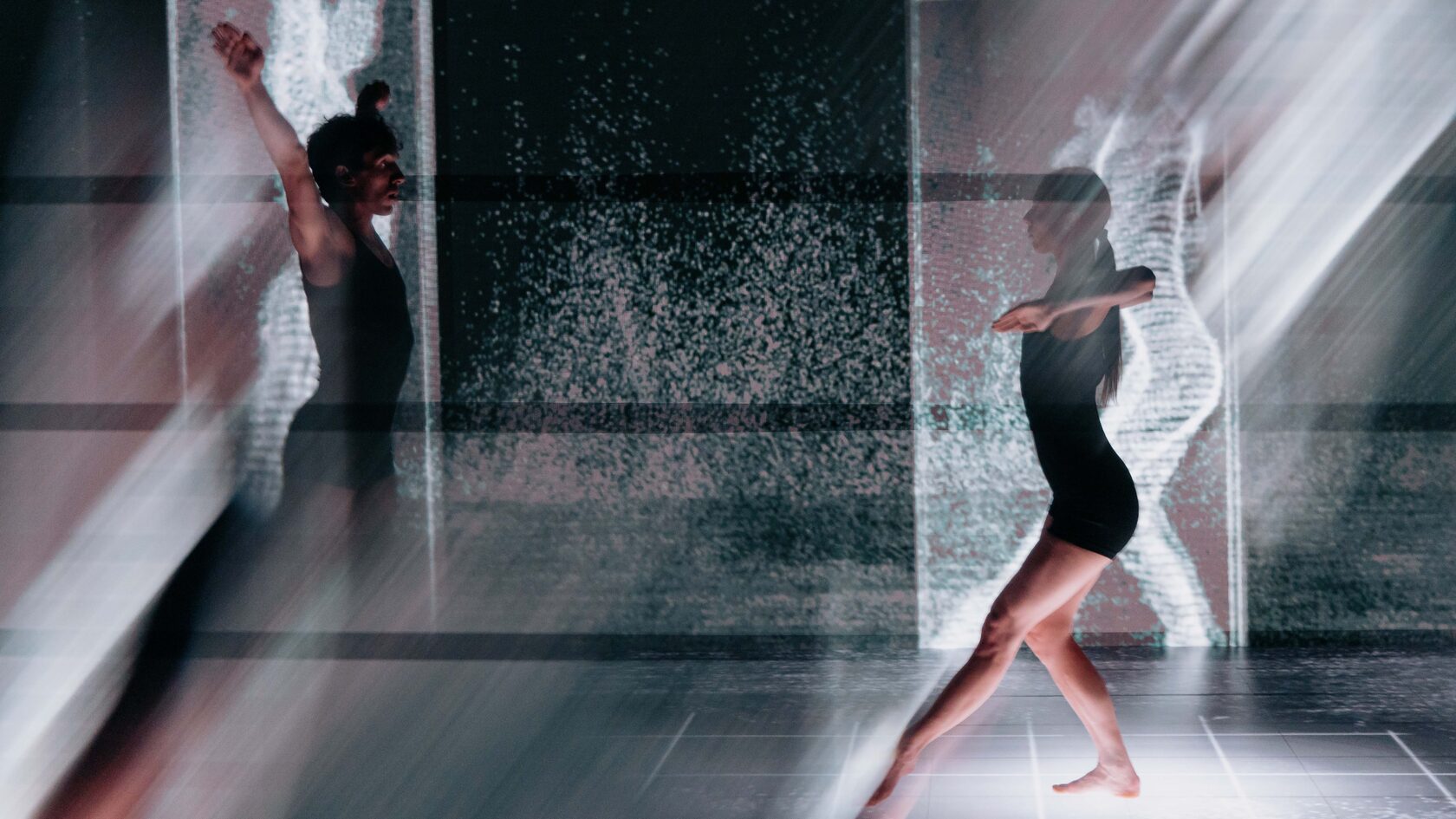
The work is based on movement, sound, and procedural graphics that emerge in real time from the performers' physicality. These elements do not exist in isolation, but as a single, functioning mechanism, where "we" becomes not the theme, but the very form of the work. We use state-of-the-art motion capture technology to transform gesture, rhythm, and physical presence into a visual and auditory language that allows the audience to literally step into the concept of the performance. This creates an environment in which individual movement becomes part of a shared field, and personal impulse becomes part of a collective structure.
The work is based on movement, sound, and procedural graphics that emerge in real time from the performers' physicality. These elements do not exist in isolation, but as a single, functioning mechanism, where "we" becomes not the theme, but the very form of the work. We use state-of-the-art motion capture technology to transform gesture, rhythm, and physical presence into a visual and auditory language that allows the audience to literally step into the concept of the performance. This creates an environment in which individual movement becomes part of a shared field, and personal impulse becomes part of a collective structure.
"WE" is an audiovisual performance in which the metropolis is portrayed as a unified neural system. It invites viewers to see the city as a complex network of interconnections, whose rhythms and patterns resonate with the structure of the universe itself.
Through sound, movement, and visual imagery, the performance explores a state of ordered chaos: moments of activity and stillness, the connection between the individual and collective experience, and the sensation of countless personal trajectories constantly intersecting with one another.
An important part of the performance is the dancers' interaction with the multimedia environment — an attempt to model new forms of audiovisual communication between people, technology, and space.
Through sound, movement, and visual imagery, the performance explores a state of ordered chaos: moments of activity and stillness, the connection between the individual and collective experience, and the sensation of countless personal trajectories constantly intersecting with one another.
An important part of the performance is the dancers' interaction with the multimedia environment — an attempt to model new forms of audiovisual communication between people, technology, and space.
"The performance "WE" grew out of a long-term observation of how people, the environment, and the invisible systems that connect us are structured. Ever since childhood, I have been collecting what happens around me into my own internal "black box": through sight, hearing, intuition, physical reaction, and through the constant recording of events and their subsequent interpretation. This process never stops as long as humans exist. It was precisely from this that the idea for the performance was born — as an attempt to capture what is usually elusive: the hidden patterns, connections, impulses, tensions, and structures that shape our society and our perception of reality".
Alexandr Kozlov


"It is important that the viewer not merely see the form, but feel as though they themselves are inside a system of processes that affect each and every one of us. The performance suggests that today we all live in a space of constant change, where a multitude of events, signals, and states are governed by invisible patterns. And yet it is precisely we — through our bodies, our sensitivity, our attention, and our shared presence — who can reveal these patterns, make them visible, and experience them as a collective event. We cannot remain silent about what is happening in the world right now. But instead of a direct statement, we choose a different path — the path of bodily, auditory, and visual experience, in which "we" resonate like the nervous system of time".
Alexandr Kozlov


The audiovisual work is complemented by a dance performance by Svetlana Lenichko and Kirill Ivanov. The artists explore how bodily movement can serve as yet another way to convey the rhythms of the city, its interconnections, and collective experiences.


"It is important to me to explore the interaction between humans and technology, where the body serves as a conduit between the physical and digital worlds. I am exploring which movements engage most expressively with the media and how technology, in turn, shapes physical action".
Svetlana Lenichko


"I think the difference between a performance at the intersection of dance and media art and a conventional dance performance is fundamental. In a dance performance, choreography is the foundation. The main emphasis is on technique, physical expression, and artistic imagery. The audience member is usually an observer. In a performance, however, dance may be just one means of expression—alongside text, video, graphics, sound, and objects. Often, the idea and the exploration of a theme are more important than the technical execution itself. The audience member, meanwhile, often becomes a participant in what is happening."
Kirill Ivanov


